Problem
If you use ZappySys JDBC-ODBC Bridge in a rare case scenario, you may face the following error.
No connection could be made because the target machine actively refused it 127.0.0.1:50433
Possible Cause
This error usually happens due to two reasons
- Default Port
50433(for JDBC Bridge) is used by another application and is causing conflict with ZappySys JDBC Bridge Driver
-OR- - Default Port
50433is part of the reserved port ranges
How to check if port used by another application?
- To check which process uses this port, you can use tools like [Resource Monitor] or TcpView.
- On Windows, search “Resource monitor” in the start menu and open it. Go to Network Tab > TCP Connections Panel.
- Sort by “Local Port” column and find which process is holding port 50433
How to check if the port is in the reserved range?
- Open the command line as an administrator
- Run the following command
netsh int ip show excludedportrange protocol=tcp - If you see a range like below, that means 50433 is part of that reserved range.
50400 50600
Possible Fix
Let’s look at two possible solutions to fix this issue.
Change the default port to another port (For New Version)
If you have ODBC PowerPack v2.0.2 or higher, then you can change the default port.
- Go to ZappySys ODBC Installation directory (Usually below location)
C:\Program Files (x86)\ZappySys\ZappySys ODBC PowerPack - Find the file name
JdbcBridge.properties - File not found, create a new file using the below command (Replace 12345 with any random port not used by any application)
echo app.port=12345 > "C:\Program Files (x86)\ZappySys\ZappySys ODBC PowerPack\JdbcBridge.properties"
- If the file is already found, just open in any text editor and change the following line if found else add a new line (Replace 50433 with any random port not used by any application)
app.port=50433 - Save file changes
- Now, try to test JDBC Bridge again, and see if the error is resolved
Restart Windows NAT Driver service
- Open the command line as an administrator
- Run the following command
net stop winnat && net start winnat - You will see output like this
C:\Windows\system32> net stop winnat && net start winnat

The Windows NAT Driver service was stopped successfully.

The Windows NAT Driver service was started successfully.
- Now try to test JDBC Bridge again, and see error is resolved
Restart java.exe to reload new settings
If you made changes to JdbcBridge.properties, a very important step is to restart java.exe manually if it’s still using the old port.
- Open Windows Task Manager (search “task manager” in start menu)
- Go to Details Tab
- Sort by name
- Find java.exe
- Right click and End process tree (NOTE: If you see multiple java.exe and are not sure if it’s the right one launched by ZappySys, then add the Command Line column to confirm. Any command-line invocation of JdbcBridge.jar is launched by ZappySys.

How to check if a port is used by any application (use netstat)
After changing to the new port, you can confirm whether the old port is still in use with the following command.
- Open the command line
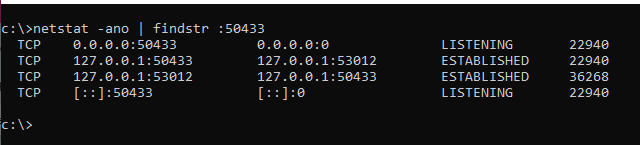
- Run the command below (change the port to whatever port you want to search)
netstat -ano | findstr :50433 - If Port not used, you will see a blank; else it may showa few entries like below
How to check which process is holding this port
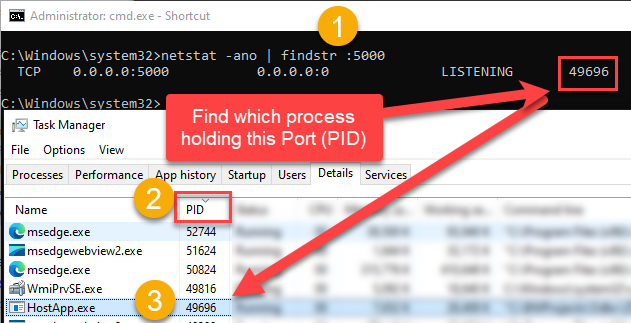
Here’s a clearer version of the text:
To identify which process is using a specific port number, follow these steps:
- Run the command to search for the port and note the PID (Process ID), which is the last column in the console output. This PID corresponds to the process that is holding the port.
netstat -ano | findstr :5000 - Open the Task Manager.
- Navigate to the Details tab.
- Sort the list by the PID column and locate the PID to match it with the console output. This will identify the process that is holding the port.
To release the port, you need to terminate this process. If possible, avoid killing it abruptly; instead, try to exit it gracefully.